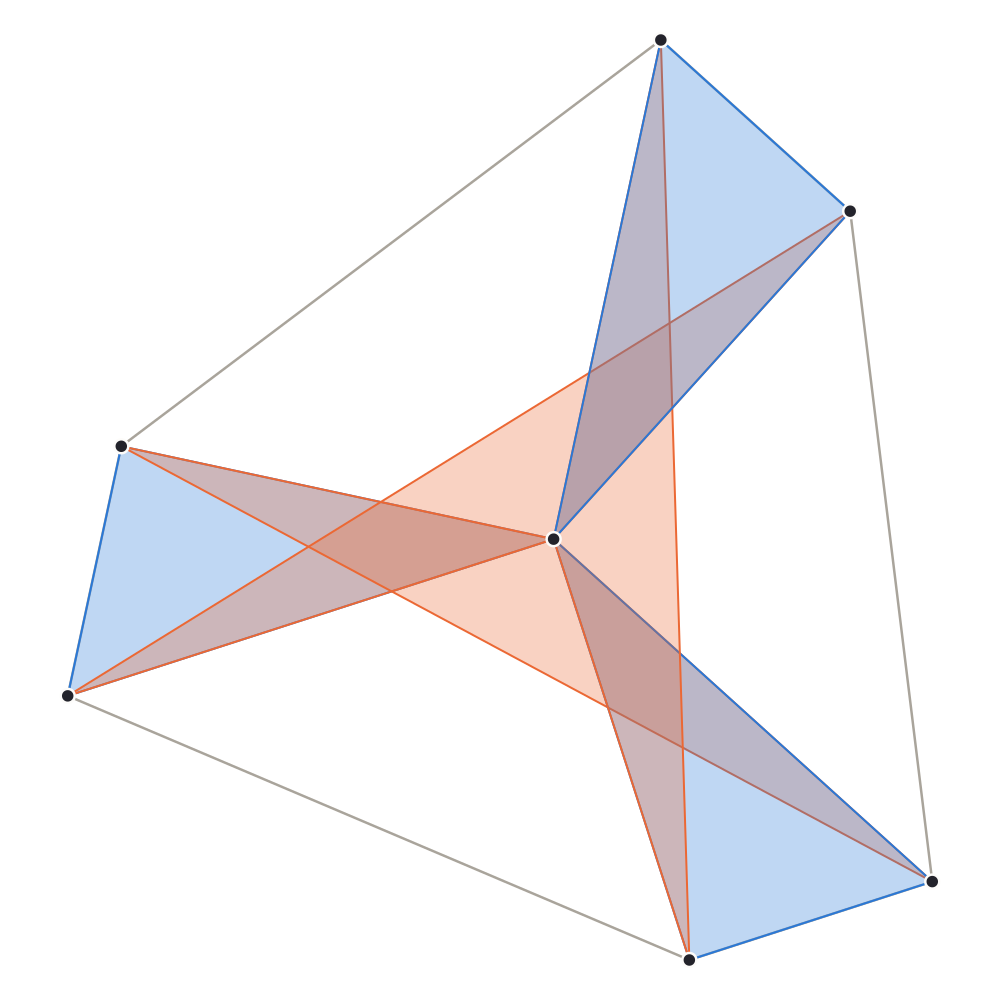
Convex, n = 7 proven
A =
= 0.111111111111111111111111111111111111111111111…
Classes
Symmetry
The family of optima
s =
Symmetry
120° Rotationally symmetric (group C3, order 3).
7 points in 3 orbits (3 + 3 + 1) — hover a point to see its orbit.
Minimal triangles
9 triangles tied (within relative 10−9) at the minimal area, in 3 congruence classes:
| count | side lengths | triangles (point indices) | |
|---|---|---|---|
| 3 | 0.5774 · 1.0000 · 1.1547 |
(0,3,6) (1,4,6) (2,5,6) | |
| 3 | 0.5774 · 1.5275 · 2.0000 |
(0,3,5) (1,3,4) (2,4,5) | |
| 3 | 1.0000 · 1.1547 · 2.0817 |
(0,4,6) (1,5,6) (2,3,6) |
Provenance
- Proved optimal by Zhenbing Zeng and Lu Yang, 1995.
- Derived exactly on this site: the optimal configurations form a one-parameter family — the center plus two equilateral-triangle orbits 30° apart, radius ratio s anywhere in [√3/2, 2/√3], every member achieving exactly 1/9. Shown: the s = 2/√3 endpoint member (9 minimal triangles), matching the published figure.
- The family is chiral: only the 120° rotation survives — no mirror-symmetric optimum exists (the mirror image is the s ↦ 1/s member of the reflected family).
- Coordinates generated from the exact construction:
data/sources/exact/constructions.py— one member (s = 2/√3, matching the published figure) of the one-parameter optimal family derived here: center + two equilateral-triangle orbits 30° apart, radius ratio s ∈ [√3/2, 2/√3], all achieving exactly 1/9. - Verified in exact arithmetic: all 35 triples enumerated, 9 tied at the minimum.
Record history
- 2026-08-22 coordinates replaced by an exact construction derived from the tie structure of the proven optimum: a one-parameter optimal family (s ∈ [√3/2, 2/√3]), shown at s = 2/√3; value exactly 1/9 (this site)
Downloads
- points.txt coordinates, tab-separated
- points.csv coordinates, CSV
- points.json full record: value, provenance, verification
- figure.svg this figure
- family.json the optimal family: exact endpoints, 30-decimal sample members