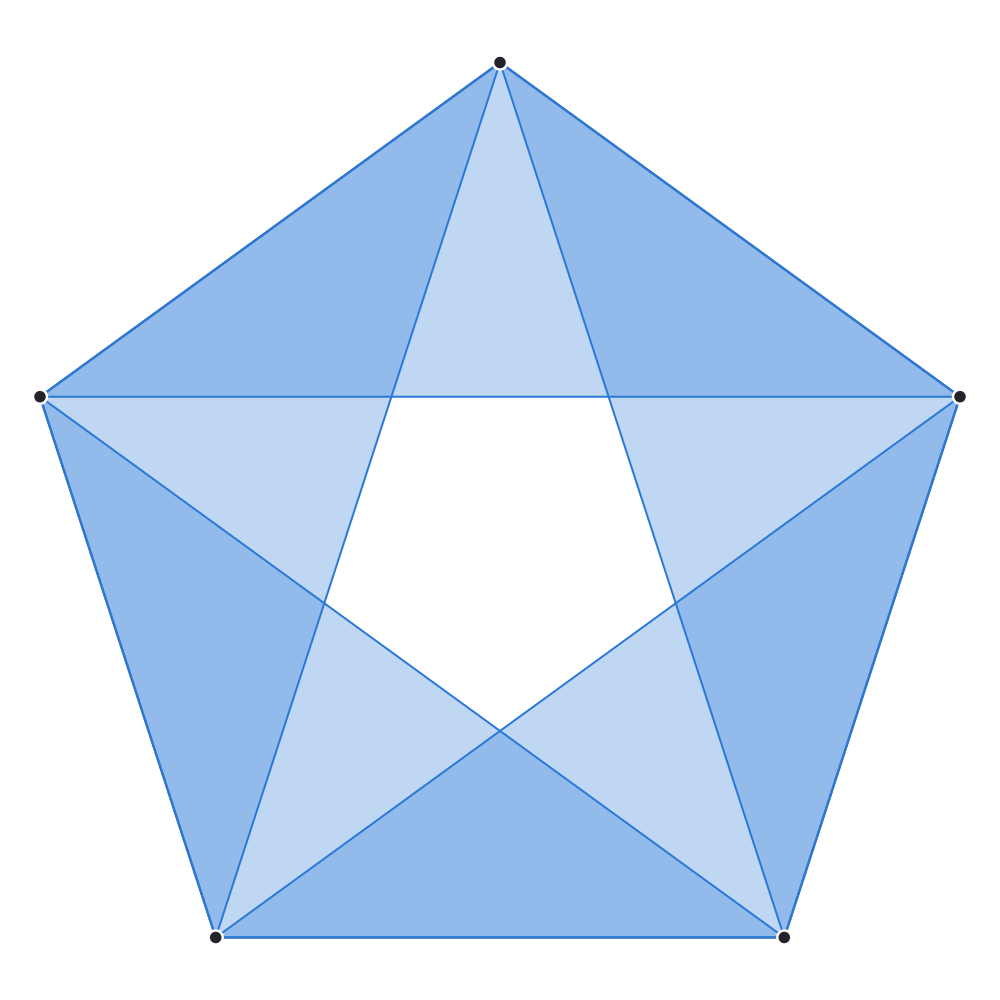
Convex, n = 5 proven
A =
= 0.276393202250021030359082633126872376455938164…
root of — regular pentagon: three consecutive vertices span 4 sin²36° / 5 of its area
Classes
Symmetry
Symmetry
5-fold dihedral symmetry (group D5, order 10).
5 points in 1 orbit (5) — hover a point to see its orbit.
Minimal triangles
5 triangles tied (within relative 10−9) at the minimal area:
| count | side lengths | triangles (point indices) | |
|---|---|---|---|
| 5 | 1.1756 · 1.1756 · 1.9021 |
(0,1,2) (0,1,4) (0,3,4) (1,2,3) (2,3,4) |
Provenance
- Found by David Cantrell, June 2007.
- Proved optimal by Tej Stead, August 2026.
- The optimality proof is machine-checked in Lean 4: value, attainment, and uniqueness of the affinely regular pentagon up to relabeling and invertible affine maps. Registered in the Palomar registry (PALOMAR-2026-09-02-000012).
- Coordinates generated from the exact construction:
data/sources/exact/constructions.py— regular pentagon. - Verified in exact arithmetic: all 10 triples enumerated, 5 tied at the minimum.
Record history
- 2026-08-22 marked proven: optimality of the regular pentagon proved by Tej Stead, August 2026 (unpublished; link to follow)
- 2026-09-02 proof link added: the August 2026 optimality proof is now machine-checked in Lean 4 and public in the site repository (proofs/palomar/heilbronn-convex)
- 2026-09-03 proof registered: Palomar registry entry PALOMAR-2026-09-02-000012 v1
Downloads
- points.txt coordinates, tab-separated
- points.csv coordinates, CSV
- points.json full record: value, provenance, verification
- figure.svg this figure